

Power-supply problems are a significant and preventable contributor to fitness equipment electronics failures. Shared circuits, worn receptacles, absent surge protection, and undersized extension cords can all stress or damage motor controllers and consoles. On the service side, the combination of line voltage and stored capacitor charge makes treadmills and self-powered bikes genuinely hazardous to work on without proper procedure.
This guide from the NCFET certified technician team covers the power-quality practices that prevent electrical failures, the GFCI behavior owners and facilities encounter, guidance on basic multimeter checks for non-electrical technicians, and the lockout and stored-energy safety procedures that protect the people doing the service. Line-voltage diagnosis and any circuit modification are work for qualified professionals — this guide clearly marks those boundaries.
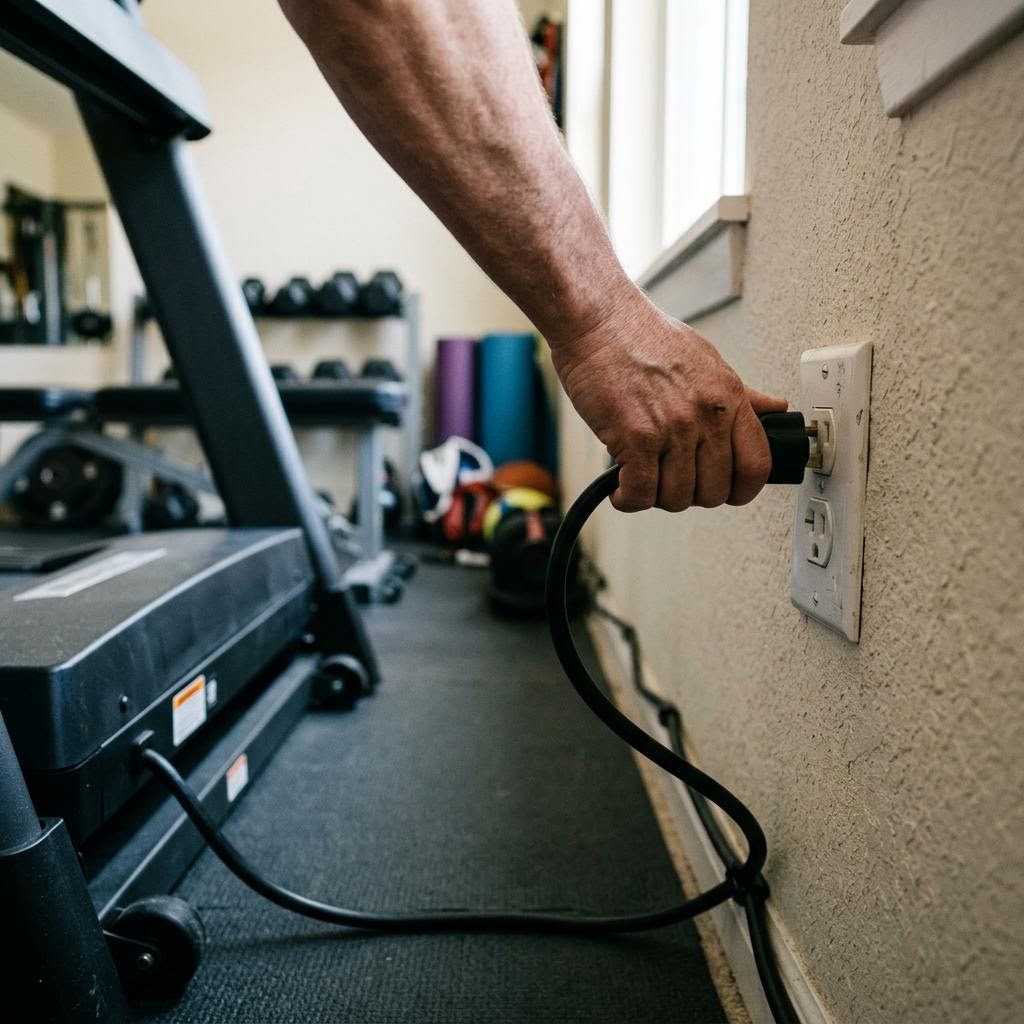
Dedicated circuits for treadmills: why they matter
A motorized treadmill under load draws current that fluctuates sharply with every footstrike and speed change. Most manufacturers specify a dedicated branch circuit — one treadmill, nothing else on the branch — for commercial installations, and strongly recommend the same for home use. In the U.S., commercial treadmills commonly require a 20-amp, 120-volt dedicated circuit, but requirements vary by model; always follow your machine's installation manual and local electrical code. On a shared circuit, current peaks from the treadmill stack on top of other loads: the result can be nuisance breaker trips, momentary voltage sag at the machine's inlet, and chronic stress on the motor controller.
In commercial installations, circuit design and installation fall under the National Electrical Code (NFPA 70) and must be executed by a licensed electrician. A fitness equipment technician's role is to recognize the symptoms of an inadequate power supply — repeated tripped breakers, units that reset mid-workout, motor controllers that fail repeatedly on the same machine after replacement — and escalate the wiring problem to an electrician instead of replacing boards indefinitely.
Signs of a shared or inadequate circuit: lights in the same room dimming briefly when the treadmill starts (motor inrush on a shared circuit), breaker trips occurring at maximum speed and incline rather than during any other operation, or the machine running fine at low speed but faulting under heavy load.
GFCI and RCD behavior: nuisance trips versus real faults
In the U.S., ground-fault circuit interrupters (GFCIs) trip on small current imbalances — typically in the low-milliamp range — intended to protect against shock. Outside the U.S. the equivalent device is called a residual current device (RCD); trip thresholds and installation requirements vary by country and local code. Treadmill motor drives produce small amounts of high-frequency leakage current through their EMI filter capacitors. On some machine-and-outlet combinations this filter leakage can trip a protective device without any insulation fault in the machine.
Where local code requires ground-fault or residual-current protection in a space where treadmills are installed, how to address a trip is a licensed electrician's decision guided by the applicable local code and the machine's installation manual. A technician must never defeat, bypass, or remove ground-fault protection as a troubleshooting step.
An important distinction: a machine that has run on a protected circuit for a long time without tripping and then suddenly begins tripping should not be assumed to be a nuisance trip. Sudden new trips can indicate developing insulation breakdown in the motor windings, a failing filter component, or moisture ingress. This pattern warrants leakage-current measurement by a qualified technician before the machine is returned to service.
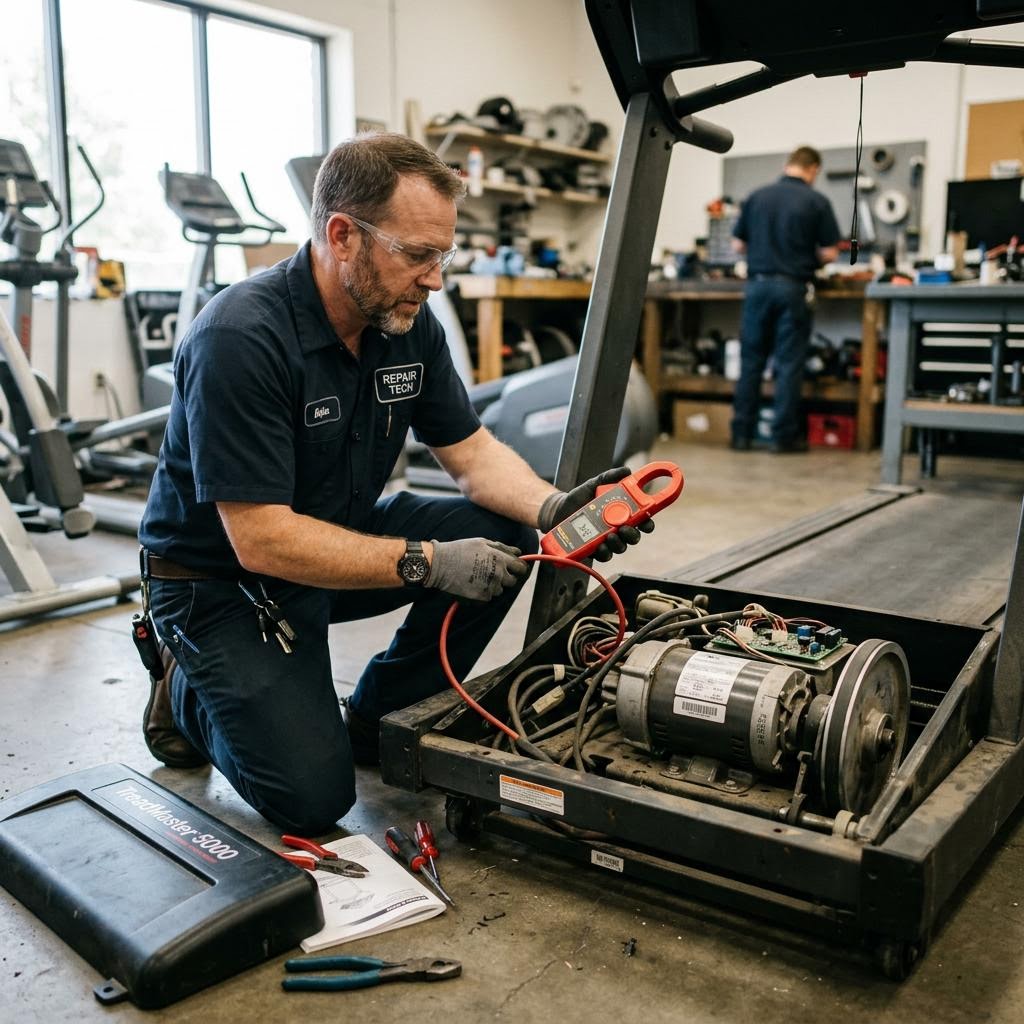
Surge protection and power strips: what works and what doesn't
Voltage transients from utility switching, nearby motor loads starting and stopping, and lightning-induced surges degrade motor controller components cumulatively — each transient causes minor semiconductor stress, and enough of them produce early board failure. A quality surge protective device (SPD) rated for the machine's current draw is cost-effective insurance for home treadmills. Commercial facilities should consider panel-level Type 2 SPDs covering the entire cardio circuit rather than individual receptacle-level devices.
A standard household power strip is not a surge protector and is not rated for treadmill starting current. Many treadmill manufacturers explicitly prohibit the use of power strips and specify a direct connection to a wall receptacle; check your machine's installation manual.
If a temporary extension cord is unavoidable during setup or service, it must be grounded, rated for the machine's amperage, and as short as practically possible — follow the manufacturer's specification for gauge and maximum length, as these vary by model. A long, undersized extension cord causes voltage drop under load that can stress the motor controller.
Basic multimeter checks a non-electrical technician can safely perform
A digital multimeter (DMM) is the first diagnostic tool for electrical complaints, and several measurements are safe for a technician to make without working on live circuits. With the machine unplugged, a technician can measure: continuity of the power cord from plug to machine inlet (both hot and neutral pins should show near-zero resistance), ground continuity from the plug's ground pin to the machine's metal frame (should be near-zero), and resistance of the motor brushes and commutator by accessing the motor brush holder per the service manual.
What requires a qualified technician: any live-voltage measurement (line voltage present on the MCB and motor leads even when the machine is 'off' but plugged in), capacitor discharge verification (motor controller capacitors hold charge after unplugging — proper discharge procedure is essential before any board contact), and any current measurement under load. Diagnosis of the motor controller itself, the power input stage, and any internal wiring is line-voltage work.
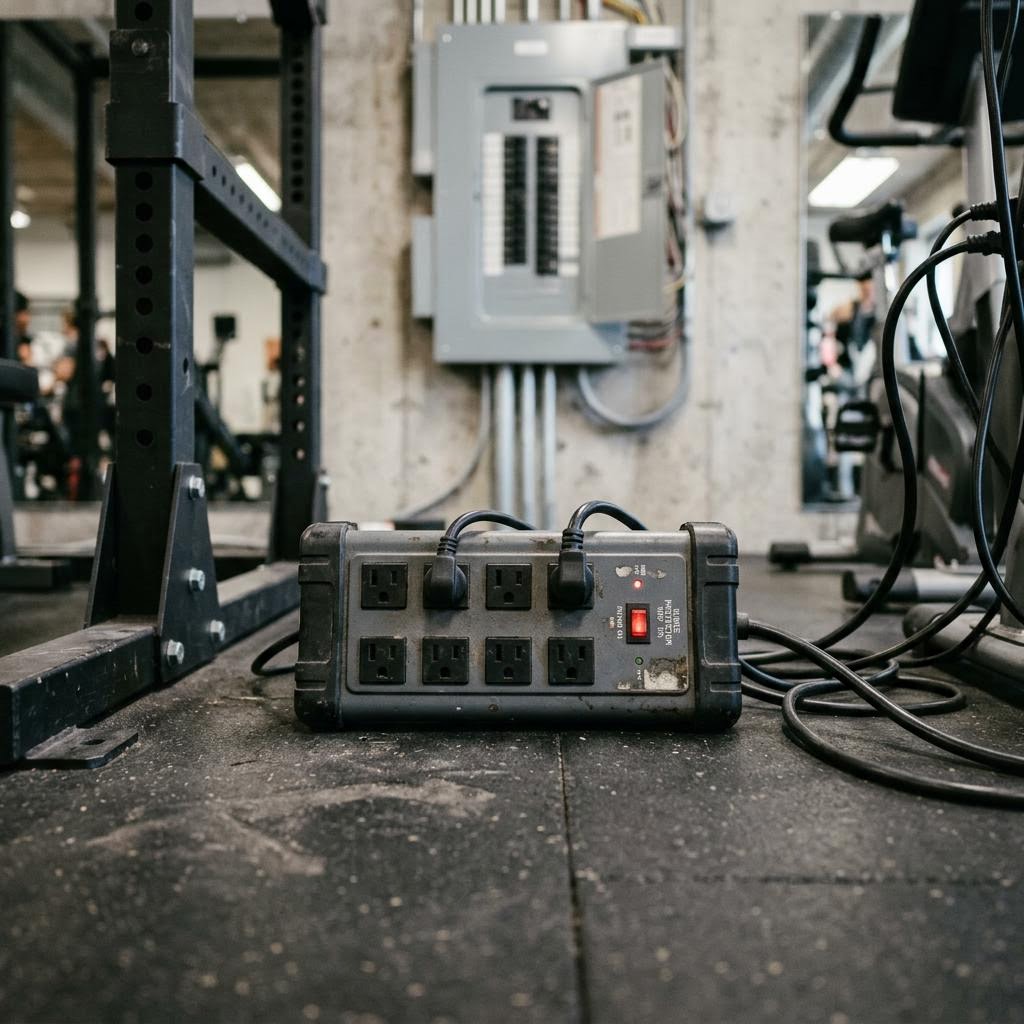
Service safety: lockout and stored energy procedures
Professional service procedure for anything beyond external cleaning: unplug the machine and physically secure the plug so it cannot be inadvertently reconnected. In U.S. commercial facilities with employees, OSHA 29 CFR 1910.147 (lockout/tagout) applies; follow your facility's specific LOTO program. Then address stored energy before touching internal components: motor controller capacitors hold charge after disconnecting power and can deliver a dangerous shock. Qualified technicians verify capacitor discharge using the procedure documented in the service manual before contacting any board components.
Self-powered equipment — generator-driven commercial bikes and some self-powered ellipticals — is energized internally whenever the crank turns, even when disconnected from the wall. 'Unplugged' does not mean de-energized on these machines. Immobilize the crank or flywheel before opening the drive housing.
Incline motors on treadmills deserve specific attention: a treadmill deck held at elevation by an incline actuator is stored mechanical energy. If the actuator is disconnected while elevated, the deck can drop suddenly. Support the frame mechanically — using the manufacturer-specified support tool or a safe equivalent — before disconnecting or servicing any incline actuator. Never trust the motor's internal drive nut as the sole support while working under or near an elevated deck.
Frequently Asked Questions
Does a treadmill really need a dedicated circuit?
Most manufacturers specify a dedicated branch circuit per treadmill — follow your machine's installation manual and local electrical code for the required rating. A shared circuit can cause nuisance breaker trips, voltage sag under load, and cumulative stress on the motor controller. If your treadmill trips breakers, reboots mid-workout, or produces MCB errors under heavy load, the circuit supply is the first thing to investigate with a licensed electrician.
Why does my treadmill keep tripping the GFCI outlet?
Two different situations can look identical: (1) EMI filter leakage inherent to the motor drive that trips a ground-fault device (GFCI in the U.S.; RCD in many other countries) on certain machine-circuit combinations without an actual insulation fault; and (2) developing insulation breakdown in the motor or wiring causing genuine leakage. If the machine has always tripped on that circuit, situation (1) is possible — consult a licensed electrician about code-compliant options. If it ran fine for a long time and recently started tripping, situation (2) warrants leakage-current diagnosis by a qualified technician before the machine runs again. Never bypass or defeat ground-fault protection.
Can I plug a treadmill into a power strip or extension cord?
Not into a standard power strip — they are not rated for treadmill inrush current, cause voltage drop, and carry fire risk under sustained motor loads. If a temporary extension cord is absolutely unavoidable, it must be grounded, meet the manufacturer's gauge specification (commonly 14 AWG or heavier), and be as short as possible. The correct permanent solution is a dedicated wall receptacle at the machine location.
What can I check with a multimeter on a treadmill safely?
With the machine unplugged: power cord continuity (both conductors, plug to inlet), ground continuity from the plug pin to the machine frame, and motor brush resistance if accessible per the service manual. Everything involving live voltage — MCB measurements, current under load, capacitor discharge verification — requires a qualified technician following proper lockout and discharge procedures. Do not probe live boards.
Is it safe to open a treadmill's motor hood myself?
Opening the motor hood to vacuum dust and debris with the machine fully unplugged is a reasonable and beneficial owner or staff task. Anything involving touching or measuring the motor controller, wiring harnesses, or internal components is technician territory: the MCB carries line voltage and stores charge in capacitors that persist after unplugging. This is precisely the safety and technical content the NCFET certification curriculum certifies technicians on.
What is lockout/tagout and when does it apply to gym equipment?
Lockout/tagout (LOTO) refers to procedures for controlling hazardous energy before servicing equipment where inadvertent startup could cause injury. In U.S. commercial facilities with employees, OSHA 29 CFR 1910.147 requires a formal LOTO program for qualifying service work; requirements outside the U.S. differ by jurisdiction. For gym equipment service, the underlying principle is consistent: unplug the machine, physically secure the plug, address stored capacitor charge before opening the control board, and immobilize self-powered cranks before accessing the drive. In a non-commercial setting the same energy-control principle applies even without a formal LOTO program.
Standards & References
- NFPA 70 — National Electrical Code
- OSHA 29 CFR 1910.147 — The Control of Hazardous Energy (Lockout/Tagout)
- ESFI — Surge Protective Devices — Electrical Safety Foundation International guidance on surge protection.
This guide is provided as a free educational resource by NCFET and its certified technician team. Always follow your equipment manufacturer's service manual, and leave line-voltage electrical work to qualified professionals. You are welcome to cite or link to this guide; please attribute it to the NCFET certified technician team and link to this page.
Related Guides
Need a professional? Or want to become one?
Find qualified service providers in the NCFET directory, verify any technician's credential at ncfet.com/verify, or start your own path to national certification.