

Clicking, squeaking, and grinding are the most common elliptical complaints — and the most misdiagnosed, because sound travels through the frame and rarely appears loudest at its source. A squeak that seems to come from the handles may trace to a ramp roller. A grinding noise that seems central may live in a flywheel bearing. NCFET-certified technicians use a rhythm-based isolation method instead of a parts-cannon approach: characterize the sound type, time it against the pedal cycle, and load-test each subsystem in a logical sequence.
This guide covers the four main noise categories — clicking, squeaking, knocking, and grinding — with the specific components each implicates and the professional repair or adjustment for each. Work through each section in the order presented; resolving a clicking fastener before chasing a squeak prevents the common mistake of attributing one combined noise to two separate sources.
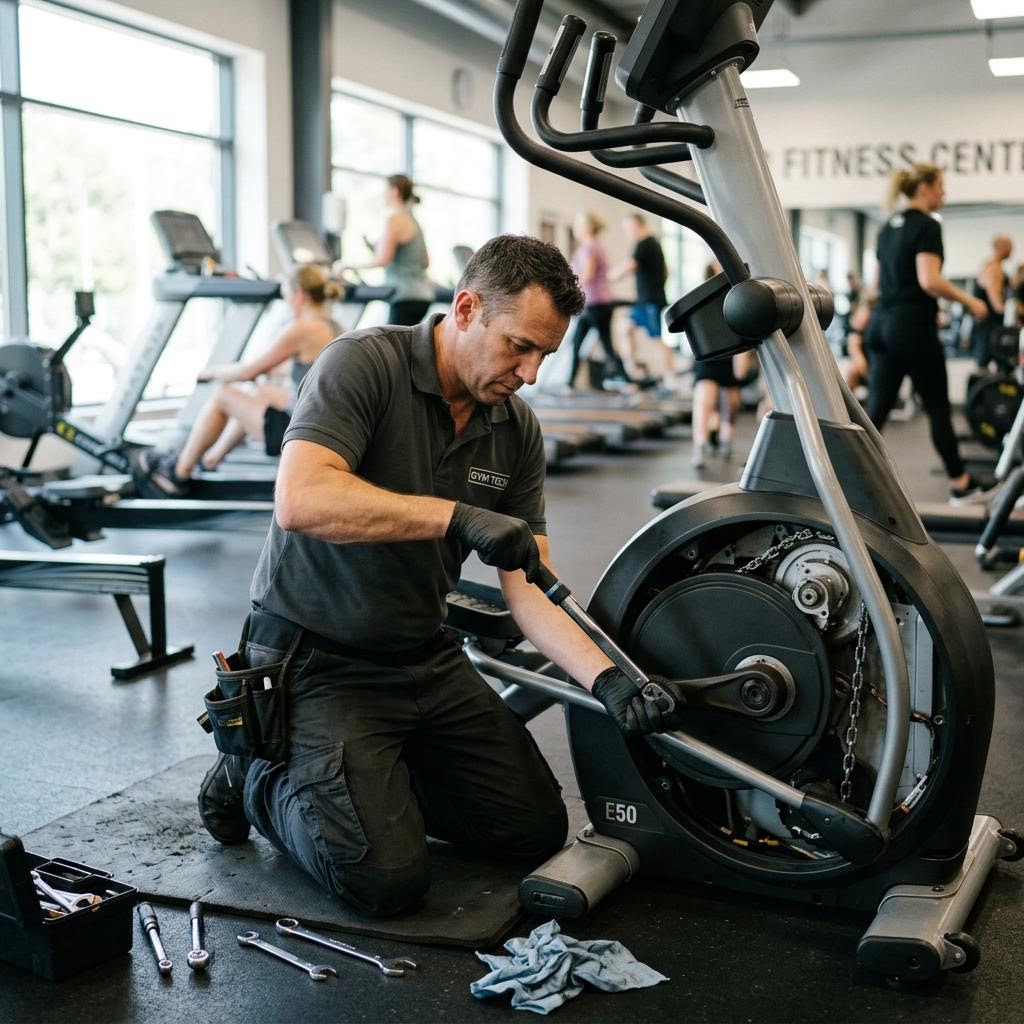
Step one: match the rhythm to the component
Every rotating element on an elliptical turns at a different speed, and its noise repeats at that rate. Before touching any fasteners, note: does the noise occur once per full pedal revolution, twice per revolution, continuously regardless of speed, or only under load? Once per pedal stroke implicates components turning at crank speed — pedal bolts, pedal-arm-to-crank joints, and the crank-to-axle interface. Multiple times per revolution points to the flywheel or drive pulley, which spin faster than the cranks through the belt or chain ratio. A constant speed-independent hum or scrape under load points to the resistance braking system.
Load matters too: if the noise appears only when you push against resistance but not while pedaling lightly, the force path tells you where to look — loaded pivot joints, crank bearings, and the resistance mechanism are all candidates. A noise that disappears when you remove your hands from the handlebars isolates it to the upper-body linkage chain.
Clicking: fasteners and pivot joints — check these first
Rhythmic clicking that tracks crank speed is a common sign of a loose fastener or a dry pivot bushing. Inspect in this sequence: pedal-to-arm bolts, pedal arm to crank arm bolts, and the crank arm bolts on the main axle. Loose crank arm bolts are an urgent finding — a crank rocking on its square or tapered spindle can damage the mating surfaces with continued use, turning a re-torque into a crank or axle replacement.
Torque all crank-train fasteners to the manufacturer's specification — always consult the service manual for the correct value, as it varies by model and fastener size. Applying blue (medium-strength) threadlocker to fasteners that have loosened once is standard professional practice; it resists vibration-induced loosening without making future service impractical.
Pivot joint clicking at bushings is addressed by cleaning the pivot, applying the manufacturer-specified lubricant (commonly a white lithium grease or similar product per the manual), and reassembling. Worn-out bushings with visible play need replacement.
Squeaking: ramp rollers, wheel tracks, and the floor
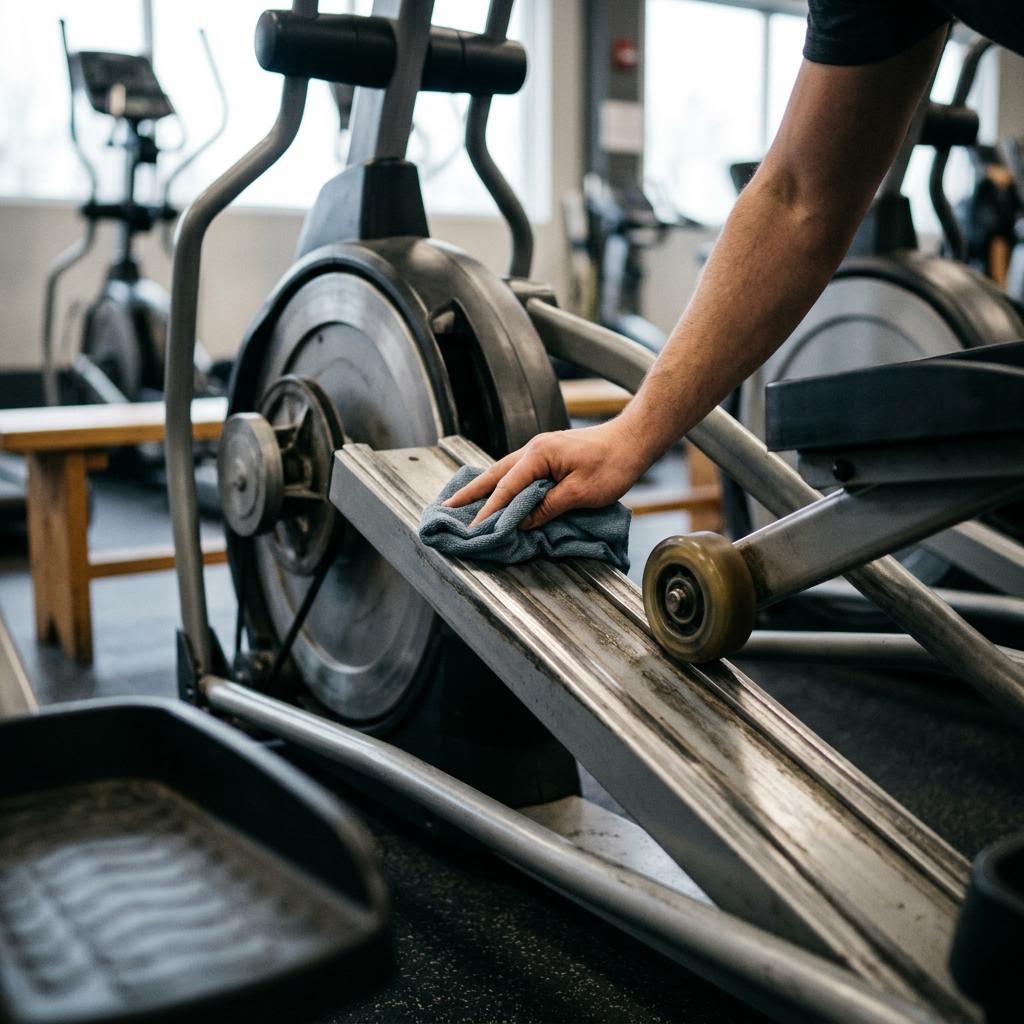
A squeak timed to the pedal cadence on rear-drive and adjustable-incline ellipticals frequently originates at the rear foot-support wheels riding the ramp or rail track. The fix sequence: (1) clean the track surface of all grit, dried lubricant buildup, and debris; (2) inspect the wheel surfaces for flat spots, cracks, or embedded material; (3) lubricate the track per the manufacturer's guidance — many specify a dry silicone lubricant or a thin film of the manufacturer-approved product directly on the rail, not the wheel; consult your service manual. Sealed bearings inside the wheels cannot be relubricated — when they feel rough or have developed lateral play, replace the wheel assembly.
Before disassembling anything for a squeak, level the machine: an elliptical that rocks microscopically on an uneven floor produces a squeak at every pedal cadence that perfectly mimics a mechanical fault inside the machine. Adjust the stabilizer feet until the machine sits solidly without rocking, then retest. This step alone resolves a surprising number of 'squeaky elliptical' service calls.
Upper-arm linkage squeaks originate at the pivot pins where the moving arms attach to the frame. These are often overlooked because the squeak sounds central. Isolate them by exercising without using the handlebars — if the squeak stops, the arm pivots are the source.
Knocking: crank/bottom-bracket area and connecting arm bearings
A knock that persists with hands off the handles and feet at mid-stroke typically lives in the crank and bottom-bracket assembly or the main connecting arm bearings. With the machine stationary and unplugged, grasp each pedal arm and try to move it laterally (axially along the main shaft) — any perceptible play in a bearing or bushing is failure and the source of the knock under load.
Crank arm knock is a specific pattern: the knock is loudest near the pedal and disappears when the load is removed. Re-torquing the crank bolt usually fixes it if the taper interface is still clean and undamaged. A crank that has been run loose and has damaged the taper interface must be replaced.
Grinding: flywheel bearings and the drive belt
Grinding that scales with flywheel speed — getting faster and louder as cadence increases — points to flywheel shaft bearings or the main drive pulley bearing. On belt-drive units, isolate the source by removing the drive belt (machine unplugged) and spinning the flywheel by hand; if the grinding persists without the belt, the flywheel bearing or its shaft is the source. If grinding disappears without the belt, the drive belt, motor/generator, or its bearings are causing it.
Sealed cartridge bearings on elliptical flywheels cannot be relubricated once they grind — internal contamination or cage failure requires replacement. Bearing replacement on the main flywheel shaft involves removing the flywheel assembly, noting that flywheel masses can be substantial and require safe support during removal.
Resistance system noise: scraping and hunting clicks
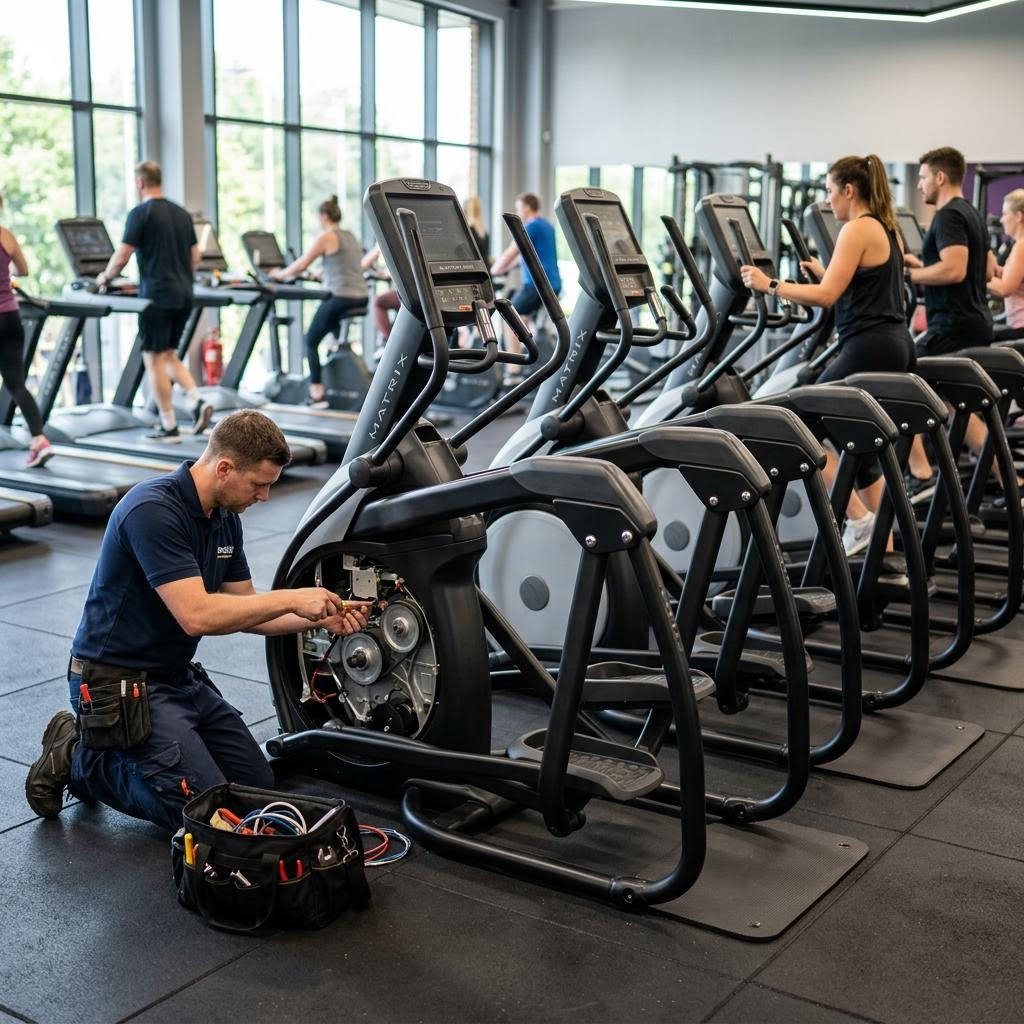
Eddy-current resistance systems are nearly silent by design — the brake magnets float close to but never contact the flywheel rim. A scraping or metallic rubbing noise under resistance means the magnet carrier has shifted or its pivot bearing has failed, allowing magnets to contact the spinning flywheel. Stop using the machine immediately: continued operation grinds the flywheel surface and compounds the repair cost. Realign or replace the carrier and confirm adequate clearance before resuming use.
Motorized resistance systems use a small stepper or servo motor to position the magnet carrier. A rapid clicking sound during resistance changes is normal motor operation. Constant clicking that continues between resistance changes indicates the position-feedback potentiometer has failed and the motor is continuously hunting without reaching its target position.
Tools & Supplies
- Metric and SAE Allen/hex key sets
- Torque wrench (crank bolts — torque to manufacturer's specification, consult service manual)
- Manufacturer-specified track/rail lubricant
- Blue medium-strength threadlocker
- Level (stabilizer feet adjustment)
- Bearing puller and press (flywheel bearing service)
Frequently Asked Questions
Why does my elliptical click once every pedal stroke?
A once-per-revolution click tracks a component turning at crank speed: pedal bolts, pedal-arm-to-crank bolts, crank arms on their spindle, or a dry linkage pivot. Loose crank bolts are a priority suspect — a crank arm rocking on its taper can damage the mating surface with continued use. Torque all fasteners in the pedal and crank chain to the manufacturer's specification before investigating bearings.
Why does my elliptical squeak with every stride?
Frequent sources include: ramp or rail wheels that need track cleaning and lubrication per the manufacturer's guidance, a flat-spotted or worn wheel bearing, a stabilizer foot that lets the machine rock on an uneven floor, or a dry upper-arm pivot. Check that the machine sits solidly level before disassembling anything — floor rocking is a frequently overlooked squeak source.
Can I lubricate elliptical bearings to stop a grinding noise?
No — most elliptical flywheel and pivot bearings are sealed cartridge units. Once they grind, the internal cage or races have failed and lubrication cannot restore them. Grinding sealed bearings require replacement. What can be lubricated (per the manual) are ramp and track surfaces, pivot bushings on some models, and the wheel contact surfaces on rails.
Why is my elliptical grinding only under high resistance?
High resistance loads the crank and flywheel bearings, making marginal bearing failures audible only when loaded. It also increases the force on the magnet carrier — if the eddy-current brake magnet carrier is slightly misaligned, it may contact the flywheel only under high magnetic load. Check bearing play and magnet carrier clearance with the machine off and the flywheel manually braked.
Is an elliptical worth repairing?
In most cases, yes. Common noise repairs — fastener torquing, pivot bushing replacement, ramp roller and wheel replacement, drive belt replacement, sealed bearing swaps — are fraction-of-replacement-cost repairs on both home and commercial units. The exceptions are cracked main frames (structural integrity concern) and budget home units with failed proprietary electronics where OEM parts are no longer available.
Standards & References
- ASTM F3023 — Standard Specification for Elliptical Trainers — The design and safety specification for elliptical trainers.
This guide is provided as a free educational resource by NCFET and its certified technician team. Always follow your equipment manufacturer's service manual, and leave line-voltage electrical work to qualified professionals. You are welcome to cite or link to this guide; please attribute it to the NCFET certified technician team and link to this page.
Related Guides
Exercise Bike Resistance Not Working: Electronic, Friction, and Magnetic Causes Explained
Read guideGym Equipment Preventive Maintenance Schedule: Daily, Weekly, Monthly, and Quarterly Checklist
Read guideGym Cable Machine Inspection Guide: Rejection Criteria and Cable Replacement
Read guideFitness Equipment Electrical Safety: Circuits, GFCI, Surge Protection, and Multimeter Diagnostics
Read guideNeed a professional? Or want to become one?
Find qualified service providers in the NCFET directory, verify any technician's credential at ncfet.com/verify, or start your own path to national certification.